A new kind of inequality
Thinking is one of the most fundamental human abilities, underpinning decision-making, learning, creativity, civic participation, adaptability and emotional well-being. It allows us to analyse situations, evaluate options, and arrive at informed choices in both everyday matters and complex challenges. Beyond problem-solving, it enables personal growth, continuous learning, the questioning of narratives, and the development of innovative solutions. Without it, our ability to navigate a complex world, build fair and creative societies and lead meaningful lives is severely diminished.
 Smyslov cultivated a clear positional style and even in sharp tactical positions often relied more on his intuition than on concrete calculation of variations. Let our authors introduce you into the world of Vasily Smyslov.
British journalist and writer Mary Harrington, an editor at UnHerd and author of Feminism Against Progress (2023), has raised the alarm about the erosion of this ability in modern society in an opinion piece for the New York Times. Known for her critiques of identity politics and the effects of globalisation, she argues that digital technology - especially smartphones - is steadily undermining concentration and reasoning. This, she warns, is creating a new kind of inequality, where the ability to think deeply is becoming an increasingly exclusive privilege.
Harrington contrasts her childhood education at a Waldorf school, where television was discouraged in favour of reading and outdoor play, with the hyper-connected reality of today. Modern life, she observes, requires conscious effort to avoid the constant distractions of the internet and mobile devices. Although IQ scores once rose consistently (the Flynn effect), she points to recent evidence of declining literacy rates in both adults and children across OECD countries, with the steepest drops occurring among those from less privileged backgrounds.
She attributes this trend to a "post-literate" culture, in which short videos and images dominate over dense written texts. As with the junk food industry's impact on physical health, low-quality, attention-fragmenting media is creating a "cognitive gap" between those who can shield themselves from it and those who cannot. Affluent families often impose strict limits on screen time, sometimes opting for expensive schools that prioritise reading and long-form learning, while poorer households may lack the resources to create such environments.
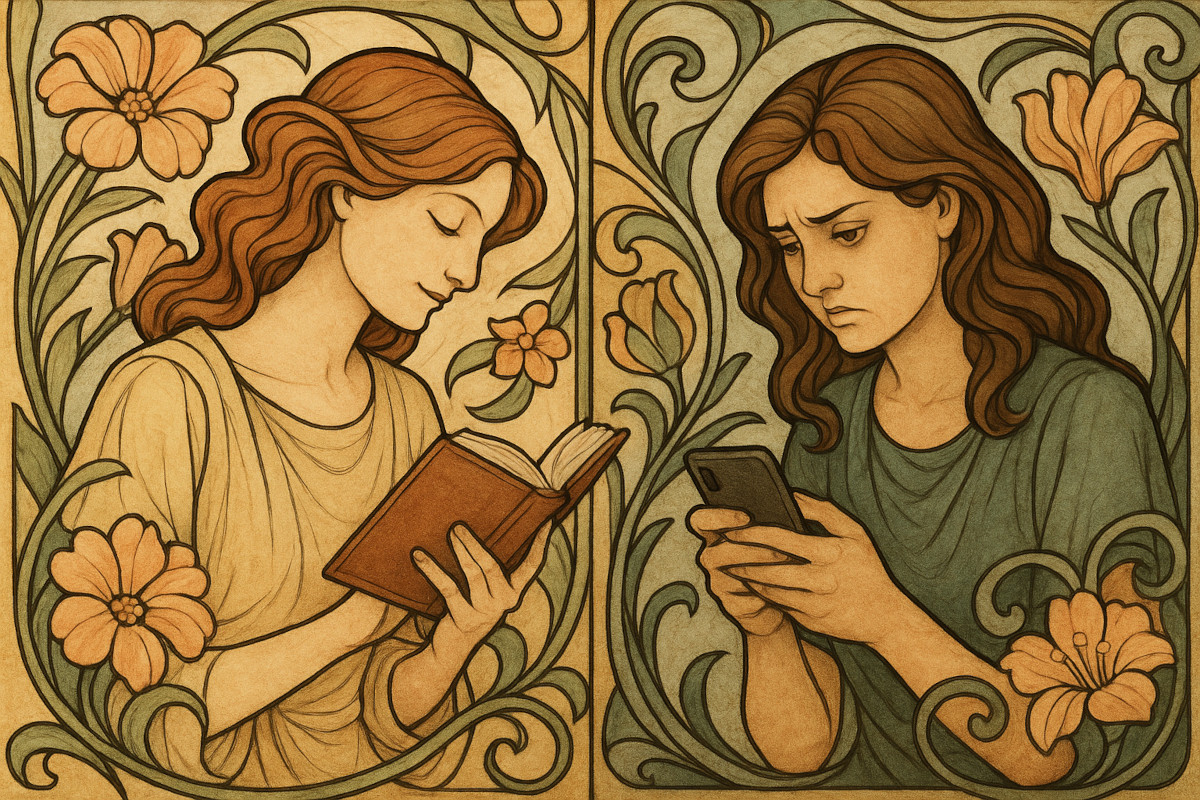
Image created with AI
 From Mating with a queen; a rook; two bishops; a knight and a bishop; to the basics of pawn endgames – here you will gain the necessary know-how to turn your endgame advantages into victories!
Harrington emphasises that deep reading is not an innate ability but a learned skill that reshapes the brain, strengthening focus, comprehension and linear thought. In contrast, digital platforms are deliberately engineered to encourage rapid switching between stimuli. This reconditions the mind towards scanning rather than analysing, eroding the mental discipline needed for sustained engagement with complex ideas. Over time, such habits make deep concentration an increasingly rare and fragile capacity.
The social and political implications, Harrington warns, are grave. A population less able to think critically and for extended periods becomes more vulnerable to manipulation, tribalism and misinformation. Public discourse risks being reduced to emotionally charged, simplified messaging rather than evidence-based argument. In such an environment, demagogues can advance their agendas through short, emotive content that humiliates political opponents, bypassing the need for coherent, reasoned debate. This dynamic could weaken democratic accountability and civic engagement.
Ultimately, Harrington's warning that "thinking is becoming a luxury good" highlights the risk of a culturally stratified society. A small, self-protective elite may preserve the skills of sustained reasoning and reflective thought, while the majority drifts into a post-literate state shaped by constant distraction. Such a divide threatens not only individual potential but also the intellectual and moral foundations of democratic society.
Links
















.jpg)