Riddle: Botvinnik–Boleslavsky, 1943

by Zoran Petronijevic
8/17/2025 – Mikhail Moiseyevich Botvinnik is undoubtedly one of the towering figures in the entire history of chess, from the birth of modern chess (circa 1495) to the present day. The subject of this article is a game Botvinnik played in 1943 (while World War II was still raging) against one of the great hopes of Soviet chess at the time - and a true innovator - Isaac Boleslavsky. Botvinnik awarded his pawn sacrifice in the middlegame an exclamation mark in all his annotations. But was he correct? | Help us unravel this riddle.

Winning starts with what you know
The new version 18 offers completely new possibilities for chess training and analysis: playing style analysis, search for strategic themes, access to 6 billion Lichess games, player preparation by matching Lichess games, download Chess.com games with built-in API, built-in cloud engine and much more.

Born in 1911 near Saint Petersburg, Botvinnik learned the game at the age of twelve – in our day, players are already becoming grandmasters at that age! He progressed rapidly and by the age of twenty, he was already among the leading players in the Soviet Union.
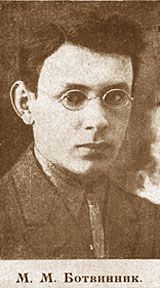
From 1936, when he tied for first place at the Nottingham tournament (with Capablanca), Botvinnik established himself as one of the world’s elite. The war interrupted his efforts to organize a World Championship match, and after the war, with World Champion Alekhine’s death in 1946, FIDE organized the 1948 World Championship tournament. Botvinnik won it convincingly, outclassing all his opponents in their mini-matches and demonstrating his extraordinary strength.

He would hold the World Championship title until 1963, with the exceptions of 1957 and 1960, when Smyslov and Tal, respectively, temporarily wrested it from him. Even after permanently losing the title in 1963 to Petrosian in a match, Botvinnik continued to achieve excellent results until he finally retired from active tournament play in 1970.

Botvinnik is widely regarded as the founder of the scientific approach to chess. Generations of chess players have learned from his creative legacy: from his games and from his deep, meticulously precise annotations, which reveal the inner content of his play. He regularly annotated his games for a wide audience in various periodicals and books. In fact, among his principles for player preparation was the belief that every major player should publish their own annotated games.

He last annotated his most important games in his monumental work Analytical and Critical Works (Moscow, 1984–1987), in three volumes (with a fourth volume containing his articles and various analyses). Since then, much time has passed. Chess has undergone an unprecedented expansion thanks to the Internet; computers and engines have become an integral part of the game (Botvinnik himself was one of the first to work on chess algorithms). Consequently, some of his commentary has inevitably become outdated. More recently, Alexander Khalifman published a collection of Botvinnik’s selected games, but this included only those that the author himself considered most significant.

It is well known that classical games remain one of the best ways to learn chess. This is confirmed, directly or indirectly, by Garry Kasparov in his monumental five-volume work My Great Predecessors, in which he analyzes the work of all the great players (in his view) up to his own era. The analysis of great masters’ games shows us the paths along which chess has developed, and from the classics we can learn a great deal about every phase of the game. Naturally, Botvinnik’s oeuvre is no exception. He was, after all, affectionately nicknamed The Patriarch of Chess.

The subject of this article is a game Botvinnik played in 1943 (while World War II was still raging) against one of the great hopes of Soviet chess at the time — and a true innovator — Isaac Boleslavsky. In 1950, Boleslavsky would share first place in the Candidates Tournament, only to lose a playoff match to Bronstein, thus missing the opportunity to challenge for the world title.

Botvinnik annotated this game in several sources, to my knowledge, for the first time in his 1949 collection of selected games, and for the last time in volume two of Analytical and Critical Works (Moscow, 1985).

Early in the game, Botvinnik sacrificed a pawn and maintained a positional initiative throughout. We are particularly interested in the position after 29.Bxf6. Botvinnik awarded this move an exclamation mark in all his annotations, regarding it as a decisive blow and asserting that his position was winning.

But was he correct?

We invite our readers to help us unravel this riddle: Was Botvinnik right in his evaluation? Furthermore, did both sides play accurately until the end, or were there hidden mistakes?

The game soon transposes into the fascinating and theoretically significant material balance of queen versus two rooks. Understanding the play in this game can help us deepen our comprehension of such positions.

We therefore invite our readers to explore this part of our game, and contribute their own analyses — to uncover the truth about this Botvinnik game and, in doing so, to fill a small gap in our understanding of his analytical legacy.

Here's the game in a ChessaBase replayer, where you can analyse with an engine and add your notes. The game can then be downloaded as a PGN, which you can send to us.

Links


Zoran Petronijevic is an IM with FIDE rating 2405 (highest 2430). Lives in the town of Nis, Serbia. For many years he played for various teams, mostly in the first division in former Yugoslavia and Serbia. His occupation is a teacher of Philosophy and Logic. Since 2003 he has worked as a chess coach. In 2004 he made a CD for ChessBase about Caro-Kann (B13-B14). He was an editor for Encyclopedia of chess endgames: pawn, and Rook Endgames for Chess Informant. His passion is literature. In chess, he is interested in history and endgames.
Discussion and Feedback Submit your feedback to the editors


Discuss

Rules for reader comments


Not registered yet? Register

Karsten Müller Karsten Müller 8/19/2025 04:37
Frits Fritschy: I agree that Botvinnik's 34.Kg2 wins as well.
Frits Fritschy Frits Fritschy 8/19/2025 03:12
I just checked it in the Dover translation of Botvinnik's 1949 book, and there he also condemns his 34th move e5. "As unsound as it is attractive. This quickly wins a pawn, but black manages to cut off the White King's retreat from the K side, and then the King is insecurely placed." He considered Kg2 to be the correct move, which is probably also winning.
Botvinnik thought 42... Rcf2 to be the decisive blunder and gives 42... Rxb2! 43.Dxd6 Tcf2 44.Dd5+ T2f7 45.e5 a4 as a possible draw and the engine agrees with the latter. The problem is that white can't trade into a pawn ending anymore.
Karsten Müller Karsten Müller 8/19/2025 10:46
Azzur: I agree from a practical point of view.
Azzur Azzur 8/19/2025 08:32
I'm not GM-level (estimated rating around 2k) but from a practical players viewpoint, I think the 2-rooks have very little chance against the queen in an open board with loose pawns and king positions. This is especially so if low in time, which is likely due to the game being near move 40.

In terms of the question of Bxf6, whilst stockfish may not have this as the best move, it is still objectively a good move. From a human perspective, it sets black alot problems and makes the white position easy to play and thus in my opinion, it is a good move.
Karsten Müller Karsten Müller 8/19/2025 05:25
Frits Fritschy: Well done! Now all is found...
Frits Fritschy Frits Fritschy 8/19/2025 01:09
I'm not going to copy all stockfish variations, but one thing that stands out in the resulting ending is the lack of safety of the white king. The move that got white's chances into jeopardy was 34.g5?, as that gives black additonal possibilities on the g-file. Stockfish rightly gives 34 Qe3!, after black is likely to lose a second pawn. It defends against Rc1+ followed by Rc2+ and if black tries to get counterplay on the f-file, just covering f2/f3 with the queen is enough to keep the king safe. One variation to show the difference is 38.Qh5+ Kg7 39.Qg5+ Kh7 40.Qd2 Rc7 and now 41.Kg2 won't work, as black has 41... Rg7+ 42. Kh2 Rgf7. You can go on for a few moves, but it's a draw.
It was a surprise to me that white isn't winning after 37.Qxb5 and maybe would have been to Botvinnik as well, if Boleslavsky had played 43... R2f3+ 44.Kg4 Kh7! instead of the again losing 43... R2f7?. The idea of 44... Kh7 is to prevent Qd5+ followed by e5 with control over f3, as in the game. Black's threat is R3f6, Q~ Rg6+ Kh3 Rf3-f2-f1+ with a perpetual. After 45.Qc5 to cover f2, black plays 45... R8f4+ 46.Kh5 Rf8. A variation to make clear why this is a draw: 47.d4 R3f7 (also good is R3f6) 48.d5 Rh8! 49.Kg4 Rg8+ 50.Kh3 Rf3+ 51.Kh2 Rgg3 52.Qc8 Rg7 (53.c5 Rgg3). The g-file!
Karsten Müller Karsten Müller 8/18/2025 05:45
albitex: Good points! But one white mistake is still missing as 31...Qd7? indeed loses and 43...R2f3+ does draw...
albitex albitex 8/18/2025 05:16
Correction: now after 42... R2f7? which allows White to push e5, Black has no hope.
I hard write 42... K2f7
albitex albitex 8/18/2025 05:09
According the engines 29. Bxf6 is a good move, even though they consider the g5 push slightly better.
However, in both cases, Black seems to be able to maintain parity. In the 1943 game, Black lost due to the incorrect defense (31... Qd7? and 43... R2f7?), if Black had played correctly Botvinnik would not have gained a decisive advantage.
Therefore, we can conclude that 29. Bxf6 is a good move, even though it would have been more accurate to precede the 29. g5 push before the Bishop sacrifice on f6.
-
29. Bxf6 (best was 29. g5 hxg5 30. hxg5 Nxg5 31. Qh5 Qd7 32. Bxf6 gxf6 33. Qg6+ Kh8 34. Nxf6 Bxf6 35. Qxf6+ Qg7 36. Rxg5 Qxf6 37. Rxf6 Re7 38. Rxd6 +=)
29... Bxf6 30. Nxf6+ gxf6 31. Rxf6 Qd7? (31...Qe5 32. Rxf7 Rc1 33. Rxc1 Kxf7 34. Qf3+ Kg8 35. Qf5 Qxf5 36. exf5 =)
32. Rxf7 Qxf7 33. Rxf7 Kxf7 34. g5 hxg5 35. Qf5+ Kg7 36. Qxg5+ Kh7 37. Qxb5 Rf8 38. Qd7+ Kg8 39. Qe6+ Kg7 40. Qd7+ Kg8 41. Kg2 Rc2+ 42. Kg3 Rcf2 43. Qxd6 R2f7?

(43...R2f3+ 44. Kg4 Kh7 45. b3 (Now White can no longer play the e5 push, otherwise Black defends himself with perpetual checks: 45. e5 R8f4+ 46. Kg5 Rf5+ 47. Kg4 R5f4+ 48. Kh5 Rf5+ 49. Kg4 R5f4+ =) 45... R3f7 46. h5 Rf6 47. Qc7+ R6f7 48. Qc1 Rf1 49. Qc7+ R1f7 =)

44. Qd5 Kh8 (Now after 42... K2f7? which allows White to push e5, Black has no hope) 45. e5 Rg7+ 46. Kh3 Rg6 47. d4 Rf1 48. Qe4 Rgg1 49. d5 Rh1+ 50. Kg4 Rhg1+ 51. Kh5 Rf7 52. e6 1-0
PhishMaster PhishMaster 8/18/2025 04:35
A computer quickly tells you that 29.g5 is a tiny bit stronger than 29.Bf6, but only initially, and is 0.00 at a depth of 58 on Stockfish 17.1.

Initially, my computer said it was +.67 to +.25 at a depth of 35, and even if that held up, that is not enough of a difference to call Botvinnik's comment wrong. I routinely preach that chess is a human game, assuming you are not playing a computer, and even if it not THE best move per a computer, a move poses the most problems for your opponent is still best when looking across the board at him. Players cannot live by evals alone, and have to realize that making a position impossible to play for your opponent is likely to bring success. It is why GMs can often win material, but continue to press for more instead.

If you have a move that wins a pawn, and is a solid +1, but instead you play a move that is 0.00, but forces your opponent to make 5 (or more), very-hard-to-find, only moves in a row leading to an eval of +10 if he misses, which is better? The first is, in a pure chess sense, but the latter in a competitive sense. It is akin to asking which is better, a hard-to-see mate-in-5, or taking your opponent's queen on the move, forcing immediate resignation? Again, chess-wise, the mate-in-five, but competition-wise, taking the queen. I cannot imagine a time where I do not take the move that forces immediate resignation.

Botvinnik was right because he made the position too difficult for Boleslavsky to play; and please note that after 31.Rf6, Boleslavsky immediately erred with 31...Qd7 instead of 31...Qe5! 32.Rf7 Rc1!!. Try finding that with Botvinnik breathing down your neck. He also evaluated the Q vs. two Rs correctly. Even later, Botvinnik was not accurate, and technically let Boleslavsky back in the game, but again, the position was very difficult, in not impossible, and Boleslavsky erred again, allowing Botvinnik to win.

Lastly, I would say that Tal was Tal because of the problems he posed to his opponents.
Karsten Müller Karsten Müller 8/18/2025 03:32
albitex: Yes removing the knight from e5 (not e4) indeed looks like a provocation. It is playable but not a good choice...
albitex albitex 8/18/2025 03:18
Before analyzing, I would like to say that at first glance, intuitively it seems to me that removing the black Knight from e4 (28... Nf7?!) when White has two Rooks, a Bishop and a Knight targeting the f6-pawn and two pawns on h4 and g4 clearly ready to undermine castling, seems like a provocation to push for a capture on f6.
arzi arzi 8/18/2025 11:41
29. Bxf6 (+/-0.87) was not a mistake in itself, but a slightly better move would have been 29. g5 (+/-1.25), but even this might not have guaranteed a win. The real mistake for Black was 31...Qd7. 31...Qe5 would have been significantly better. I don't see a direct win for White. 32. Rxf7 Rc1 33.Rxc1 Kxf7 34. Qf3+ Kg8
1