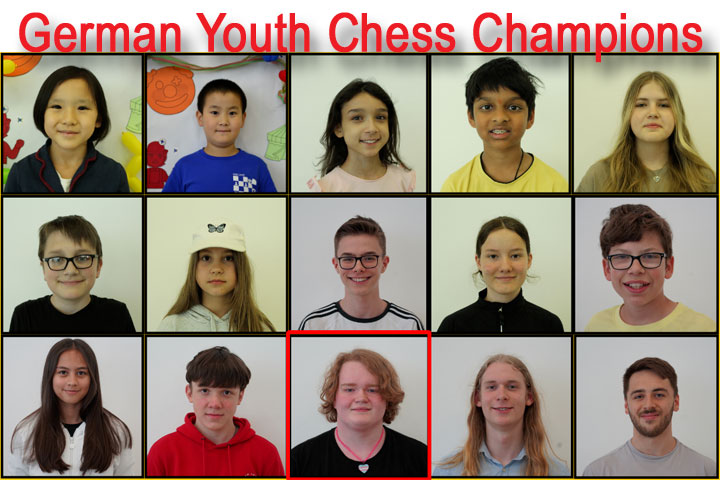
The article discusses the ongoing debate about the participation of trans women (biological males who identify as female) in women's chess competitions, sparked by the recent victory of Nora Heidemann in Germany's girls' under-18 tournament. Some in the chess community, like Nadja Jussupow, worry that the increasing presence of trans women in women-only events could discourage female players from competing. She claimed that more trans women were entering women's chess tournaments since the introduction last year of Germany's Self-Determination Act: "They merely declared themselves to be women."
 The Alapin Variation (1.e4 c5 2.c3) offers a simple yet highly effective solution to all major Sicilian lines, by sidestepping them with 2.c3.
Facing the Sicilian doesn’t have to be complicated. The Alapin Variation (1.e4 c5 2.c3) offers a simple yet highly effective solution to all major Sicilian lines, by sidestepping them with 2.c3. Whether your opponent plays the Najdorf, Taimanov, or Dragon, the Alapin lets you take control of the game as early as move two.
Free video sample: Introduction
Free video sample: 2...g6
The chess governing body FIDE currently bans trans women from women's events, partly arguing that physical endurance, which could be influenced by sex, plays a role even in chess. This view is contested: some, like Labour MP Angela Eagle, deny any real physical advantage for men; others, like Alexandra Kosteniuk and Hou Yifan, insist elite chess is physically and psychologically taxing, and that differences may exist. "It's almost impossible to explain to non-chess-players how physically demanding the game is," wrote Kosteniuk, "and how hard, physically and psychologically, it is to compete in world championship-level competition."
Lawson's article notes that while most chess tournaments are "open" to both sexes, men dominate the very top levels—China's Hou Yifan, the strongest female player, is ranked just 96th in the world. "When, 11 years ago, I played a game against Hou," Lawson writes, "and was ground down remorselessly in 45 moves, I asked her why women were outperformed so widely by men at the highest level." Her reply: "There is a physical side. In chess sometimes you play for seven to eight hours. Based on history, I don't see any chance of a woman becoming the world's strongest player." So, no real-world version of the Netflix drama The Queen's Gambit, Lawson thinks.
Some suggest women's lower representation among top players is due to social and cultural factors or lower participation rates. However, evolutionary biologist Carole Hooven points out that even in games like Scrabble and bridge—where women's participation is equal or higher—men still dominate the elite ranks. She suggests that men may be biologically more disposed to the obsessive single-mindedness needed to reach the very highest levels in chess and similar pursuits.
The article concludes that, whether because of physical, psychological, or social factors, men continue to outnumber women at the very highest levels of chess—and this could have implications for how trans participation in women's events is viewed.

About the author
Dominic Ralph Campden Lawson (born December 17, 1956) is a British journalist and editor known for his strong opinions on political and social issues. He is the elder son of Nigel Lawson, a former Conservative politician and Chancellor of the Exchequer. Dominic was educated at Westminster School and Christ Church, Oxford. He worked at the BBC, wrote for the Financial Times, and was editor of The Spectator magazine (1990-1995) and The Sunday Telegraph (1995-2005). He has written columns for The Independent and The Sunday Times, among others. Dominic Lawson is the president of the English Chess Federation (ECF).


















.jpg)
