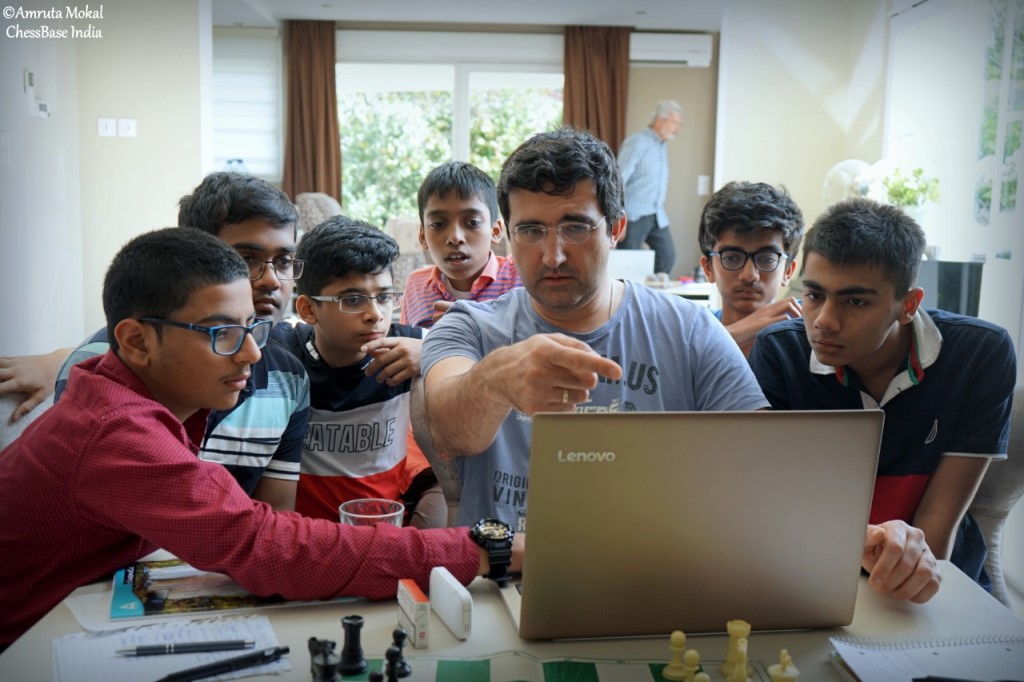
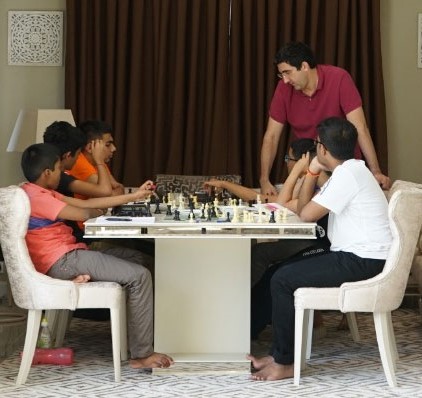
10/2/2020 – In the latest episode of ‘In conversation with...’, Surya Shekhar Ganguly talked for an hour and a half with former world champion Vladimir Kramnik. The Russian star, who retired from classical chess almost two years ago, discusses some of his games, refers to the young Indian players he recently trained and shares a bit of the wealth of knowledge he gathered during his career. | Photo: Amruta Mokal
Your personal chess trainer. Your toughest opponent. Your strongest ally. FRITZ 20 is more than just a chess engine – it is a training revolution for ambitious players and professionals. Whether you are taking your first steps into the world of serious chess training, or already playing at tournament level, FRITZ 20 will help you train more efficiently, intelligently and individually than ever before.
Winning starts with what you know The new version 18 offers completely new possibilities for chess training and analysis: playing style analysis, search for strategic themes, access to 6 billion Lichess games, player preparation by matching Lichess games, download Chess.com games with built-in API, built-in cloud engine and much more.
Fittingly, Vladimir Kramnik starts the conversation talking about his approach to chess, heavily influenced by the fact that he had an artist and a music teacher as parents. The Russian goes even further and says:
I think most top players are artists in their own way, because I think you cannot really get into the very top just being a kind of point-making machine or money-cashing machine.
The conversation then goes into the subject of competitiveness, with Kramnik noting that he is not a particularly competitive person, as winning “is not a dominant motivation”. He acknowledges that most sportsmen do not share this perspective, and reminisces on the period in which he tried to be more competitive:
Our experts show, using the games of Botvinnik, how to employ specific openings successfully, which model strategies are present in specific structures, how to find tactical solutions and rules for how to bring endings to a successful conclusion
I even tried it myself, as an experiment, to be, you know, very result-oriented, even angry, very aggressive — but it never worked. I just understood it’s not [my style]. Usually when I play I’m just fully concentrated on the game, on the board. I never have anything against my opponent at all, not a single negative feeling. [...] Like Robert James Fischer’s famous sentence — I don’t know if it was very sincere or more for the public — that his biggest pleasure was to see his opponent’s ego getting demolished. For me that’s totally alien.
Kramnik is known for having changed styles frequently during his career, experimenting with different openings and approaches despite having to face the strongest players in the world. The former world champion explained with a smile:
Something switched in my mind. I mean, somebody, not really me, kind of switched the settings in my brain. [...] It’s not really that I planned it, or it was connected with a certain clear goal. I was lucky that this switch that happened at the end of the 1990s happened just before my match with Kasparov — that was luck, because it was exactly what I needed to play against Kasparov, it was excellent timing.
Undoubtedly, Kramnik’s most successful tournament was the Sparkassen Chess Meeting in Dortmund, an event he remarkably won ten times. Ganguly brought up the position he had against Nigel Short in 1995, the first time he won the event. Kramnik commented:
Somehow everything was going so smoothly in this event. Everything that I wanted was working. You know, these happy events in which, whatever you do, it works. And also Nigel Short was an extremely strong player at the time, and I beat him very easily and quickly, and it was quite surprising for me.
These DVDs are about Understanding Middlegame Strategies. In the first DVD dynamic decisions involving pawns are discussed. The second DVD deals with decision making process concerning practical play.
After going over another game from Dortmund, but from 2011, against Giri, Ganguly reminds Kramnik of a game he played against Ivan Sokolov in Wijk aan Zee 2005. The position was memorable for the host, because he was both at the venue and during the analysis session, when Kramnik declared that he had seen the eventual mating net that appeared on the board after 28.a4 in the following position:
White went on to use the open g-file to create a deadly attack against Black’s king. This sequence reminded Kramnik of a similar idea he used in a rapid game against Levon Aronian from 2015.
A discussion about endgames then began, with Kramnik explaining:
I liked endgames from the beginning. That was one of the reasons Botvinnik liked me a lot, because even at the age of 12 I always used the chance to go to an endgame. He was extremely happy when during one of the sessions I was showing some game — at that time I knew absolutely no theory since I never had a trainer — so I was always playing 1.e4 c5 2.f4 [...] and at some point I decided that after 2...d5 I can play 3.Bb5+ Bd7 4.Bxd7 Qxd7 5.d3 and 5...dxe4 6.dxe4 Qxd1 7.Kxd1. I showed the game where I won this endgame, and Botvinnik was so happy.
At the Qatar Masters 2014, ‘Big Vlad’ demonstrated how strong he had become in handling endgames since his childhood, in this case in a rook and knight endgame against Salem Saleh.
Of course, the former world champion also excelled in calculation and, to prove that he was still going strong even in the last years of his career, Ganguly set up the board with a position Kramnik had against Magnus Carlsen at the 2017 Norway Chess Tournament, when the Russian went for an astounding attack that started with a bishop sacrifice on h6.
Kramnik noted that this was the last decisive classical game against Carlsen, and said:
It was a memorable game. Actually it was the last decisive classical chess game between me and Magnus and it ended in my victory — it might not mean much, but still it’s nice (smiles).
It was a remarkably precise tactical sequence.
The amiable conversation continued, with Ganguly and Kramnik going over other greatest hits of the Russian’s career — and a couple of missed opportunities. Of course, they also remembered how ‘Big Vlad’ had wished for both Russia and India to win this year’s Online Olympiad, and how his wish had been granted!
This DVD allows you to learn from the example of one of the best players in the history of chess and from the explanations of the authors (Pelletier, Marin, Müller and Reeh) how to successfully organise your games strategically, consequently how to keep y
Whether you‘re a beginner looking for a clear roadmap or an advanced player ready to refine your strategic edge, this comprehensive course will transform the way you think about chess.
Biel Chess Festival 2025 with analyses by Aravindh, Navara, Wojtaszek et al. Opening videos by Blohberger, Engel and Sokolov. Training columns ‘The fortress’, ‘Opening traps , ‘Fundamental Endgame Knowledge’ and much more
If you are looking for a practical, easy-to-learn system to sidestep the main lines and catch your opponent off guard, the Two Knights Variation is your perfect weapon against the French!
In this 60-minute course, IM Andrew Martin introduces you to a flexible and refreshingly simple opening setup - that Grandmaster Hikaru Nakamura has used to rack up numerous impressive wins.
ChessBase is re-releasing this timeless classic in the modern ChessBase Media format - complete with brand-new training features. Get ready to rediscover a masterpiece of chess instruction!
We use cookies and comparable technologies to provide certain functions, to improve the user experience and to offer interest-oriented content. Depending on their intended use, analysis cookies and marketing cookies may be used in addition to technically required cookies. Here you can make detailed settings or revoke your consent (if necessary partially) with effect for the future. Further information can be found in our data protection declaration.
Pop-up for detailed settings
We use cookies and comparable technologies to provide certain functions, to improve the user experience and to offer interest-oriented content. Depending on their intended use, cookies may be used in addition to technically required cookies, analysis cookies and marketing cookies. You can decide which cookies to use by selecting the appropriate options below. Please note that your selection may affect the functionality of the service. Further information can be found in our privacy policy.
Technically required cookies
Technically required cookies: so that you can navigate and use the basic functions and store preferences.
Analysis Cookies
To help us determine how visitors interact with our website to improve the user experience.
Marketing-Cookies
To help us offer and evaluate relevant content and interesting and appropriate advertisement.











 Fittingly, Vladimir Kramnik starts the conversation talking about his approach to chess, heavily influenced by the fact that he had an artist and a music teacher as parents. The Russian goes even further and says: