2/9/2025 – Rook endgames are often deceptively complex, with even top grandmasters struggling in seemingly straightforward positions. In "Endgame essentials you need to know", Surya Shekhar Ganguly explores key endgame concepts, highlighting how even the fundamental Lucena position has been misplayed at the highest level. Through real-life examples, including mistakes by Magnus Carlsen and himself, Ganguly demonstrates why mastering these essentials is crucial for players of all levels.
Your personal chess trainer. Your toughest opponent. Your strongest ally. FRITZ 20 is more than just a chess engine – it is a training revolution for ambitious players and professionals. Whether you are taking your first steps into the world of serious chess training, or already playing at tournament level, FRITZ 20 will help you train more efficiently, intelligently and individually than ever before.
Winning starts with what you know The new version 18 offers completely new possibilities for chess training and analysis: playing style analysis, search for strategic themes, access to 6 billion Lichess games, player preparation by matching Lichess games, download Chess.com games with built-in API, built-in cloud engine and much more.
Rook endgames are notoriously difficult, even for the world's best players. Positions with multiple pawns and structural asymmetries often lead to mistakes, but even the most elementary setups can be misplayed at the highest level.
In his FritzTrainer DVD Endgame essentials you need to know, Surya Shekhar Ganguly highlights this by examining fundamental endgame positions that have been mishandled by experienced grandmasters. One such case is the well-known Lucena position, a theoretically winning scenario in which a player must correctly use their rook and king to secure victory when facing a lone rook.
In this video course, GM Surya Ganguly joins IM Sagar Shah and drawing from his colossal experience, shares some uncommon endgame wisdom. The material mostly features positions with rook against rook and a pawn, and starts by covering the fundamentals.
Ganguly presents two real-life examples to illustrate how even top players can falter in these seemingly straightforward situations. He first analyses one of his own games, where he missed the win and allowed Liviu-Dieter Nisipeanu to escape with a draw. He then moves on to a game between Magnus Carlsen and Levon Aronian, in which the former world champion at the time failed to find the correct defensive sequence.
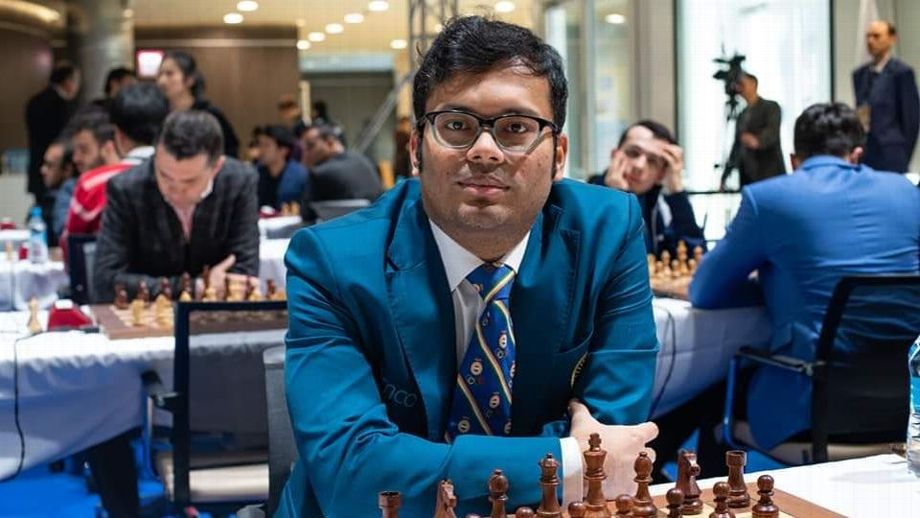
Surya Shekhar Ganguly | Photo: ChessBase India
Ganguly 0 - 1 Nisipeanu
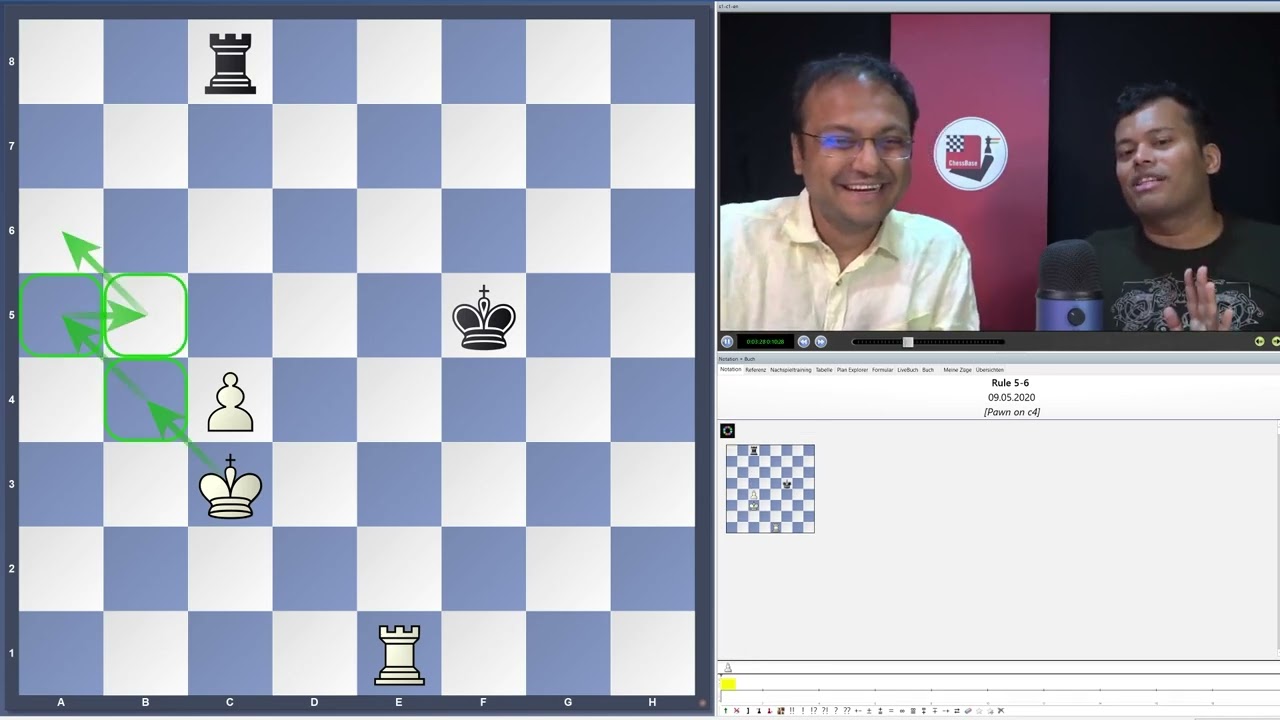
After going over a few key positions that might easily be misplayed, Surya shows this position from a 2004 game against Nisipeanu. Surya had the white pieces and reached this drawn setup after surviving a double-rook endgame.
Nisipeanu has just played 77.Re2, and as Surya himself had previously demonstrated, almost every reasonable move draws for White here. Except the seemingly logical 77...Rb3, as he played in the game!
The format of this FritzTrainer sees Surya going over the positions with ChessBase India's Sagar Shah, which makes for an enjoyable watching experience. Amid their conversation, Surya shares nuggets of wisdom in a relaxed manner. Here, he notes:
Half-remembering is the worst thing you can do - you better understand it!
Then he explains that he (half)remembered this setup from a training camp, in which he had been told that this was "an only move". What he failed to remember was the second part of the sentence:
This is the only move...that loses.
Surya played the move instantly, as he knew the position was theoretically drawn and trusted his memory without going over the details. The problem with placing the rook on b3 is that here Black wins with 77...Kf1+ 78.Kg3 f2
The problem for White is that he does not have 79.Kf3 now, a recourse that works in slightly different setups, since Black wins with 79...Kg1, and there is no stopping the pawn - i.e. as Surya points out, there is no Rg3+ available.
In the game, Surya went for 79.Kh2, and resigned after 79...Re8 80.Rb1+ Ke2.
Sagar Shah and Surya Shekhar Ganguly having a good time
Aronian 1 - 0 Carlsen
The ever-tricky Levon Aronian played 1.Rd6 in the following position against Carlsen. Here Surya asked Sagar, an IM himself, how would he have continued with black. Sagar did not take long to suggest 1...Ra7+, to which Surya joked, "...then you would be exactly like Magnus Carlsen - and that's how he lost!". Sagar quipped, "Magnus at his worst, yeah?"
After the check, White wins with 2.Ke8 Kf6 3.e7+, as played in the game - e.g. 3...Kg7 now fails to 4.Re6 Ra8+ 5.Kd7, and the passer is protected by the rook.
The only move that keeps the balance after 1.Rd6 is the difficult-to-find 1...Kg6
The main idea is that after 2.Kd7 there is 2...Kf6 3.e7+ Kf7, with a draw.
Note that Aronian did not play a winning move by placing his rook on d6, but only created a chance for his opponent to err. And even the strongest player in the world can falter while dealing with these tricky setups.
Thus, going over basic positions is never a bad idea!
In this video course, GM Surya Ganguly joins IM Sagar Shah and drawing from his colossal experience, shares some uncommon endgame wisdom. The material mostly features positions with rook against rook and a pawn, and starts by covering the fundamentals.
Carlos Alberto ColodroCarlos Colodro is a Hispanic Philologist from Bolivia. He works as a freelance translator and writer since 2012. A lot of his work is done in chess-related texts, as the game is one of his biggest interests, along with literature and music.
Whether you‘re a beginner looking for a clear roadmap or an advanced player ready to refine your strategic edge, this comprehensive course will transform the way you think about chess.
Biel Chess Festival 2025 with analyses by Aravindh, Navara, Wojtaszek et al. Opening videos by Blohberger, Engel and Sokolov. Training columns ‘The fortress’, ‘Opening traps , ‘Fundamental Endgame Knowledge’ and much more
If you are looking for a practical, easy-to-learn system to sidestep the main lines and catch your opponent off guard, the Two Knights Variation is your perfect weapon against the French!
In this 60-minute course, IM Andrew Martin introduces you to a flexible and refreshingly simple opening setup - that Grandmaster Hikaru Nakamura has used to rack up numerous impressive wins.
ChessBase is re-releasing this timeless classic in the modern ChessBase Media format - complete with brand-new training features. Get ready to rediscover a masterpiece of chess instruction!
We use cookies and comparable technologies to provide certain functions, to improve the user experience and to offer interest-oriented content. Depending on their intended use, analysis cookies and marketing cookies may be used in addition to technically required cookies. Here you can make detailed settings or revoke your consent (if necessary partially) with effect for the future. Further information can be found in our data protection declaration.
Pop-up for detailed settings
We use cookies and comparable technologies to provide certain functions, to improve the user experience and to offer interest-oriented content. Depending on their intended use, cookies may be used in addition to technically required cookies, analysis cookies and marketing cookies. You can decide which cookies to use by selecting the appropriate options below. Please note that your selection may affect the functionality of the service. Further information can be found in our privacy policy.
Technically required cookies
Technically required cookies: so that you can navigate and use the basic functions and store preferences.
Analysis Cookies
To help us determine how visitors interact with our website to improve the user experience.
Marketing-Cookies
To help us offer and evaluate relevant content and interesting and appropriate advertisement.