8/15/2021 – In this week’s column, Jon Speelman looks at the dichotomy between energy and matter in chess. While some players choose material, others go for dynamism. To illustrate his points, Speelman analyses two recent wins by Magnus Carlsen and an early game by Mikhail Tal, in which he was able to recover and win from a material disadvantage “of a mere two knights”! | Pictured: Tal at the 1964 Amsterdam Interzonal | Photo: Harry Pot / Anefo
Your personal chess trainer. Your toughest opponent. Your strongest ally. FRITZ 20 is more than just a chess engine – it is a training revolution for ambitious players and professionals. Whether you are taking your first steps into the world of serious chess training, or already playing at tournament level, FRITZ 20 will help you train more efficiently, intelligently and individually than ever before.
Winning starts with what you know The new version 18 offers completely new possibilities for chess training and analysis: playing style analysis, search for strategic themes, access to 6 billion Lichess games, player preparation by matching Lichess games, download Chess.com games with built-in API, built-in cloud engine and much more.
[Note that Jon Speelman also looks at the content of the article in video format, here embedded at the end of the article.]
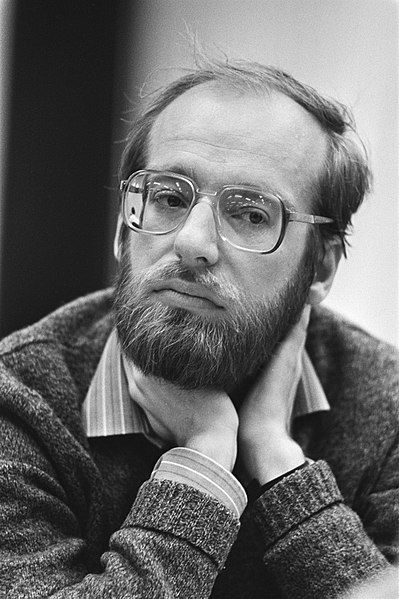
When I was one of Nigel Short’s seconds at his world championship match against Garry Kasparov in London 1993, my main sparring partner was Robert Hubner [pictured / photo by Rob Bogaerts]. Nigel had bravely decided to take Garry on in one of the sharpest responses to the Najdorf — 6.Bc4. And in those far off days, when chess computers were still in their infancy, my job was to attempt to batter the Najdorf with vast injections of energy while Robert upheld the power of matter to resist.
Sadly, I have no memory of the specifics, but he’s a superb defender, and I was often surprised and awed as my efforts foundered and I was unable to initiate fission. I remain though in my own games very much in the camp of energy rather than matter. For instance, I would normally much rather have an intact position with no material advantage but some positional plus than an extra piece in a position which “should” be defensible if not winning but gives excellent scope for the defender to go astray (though of course if the attack is ridiculous then you do have to take the piece and suffer mildly for a short while).
The value of chess pieces of course varies wildly according to position, and in the days of Alpha Zero, energy is very much in fashion (even if Stockfish beat LCZero decisively by 56-44 in their latest 100-game match).
After he loses a match, the present world champion often dissipates the negative energy with a ferocious series of blitz or bullet. After losing to Jan-Krzysztof Duda in the semi-final of the recent World Cup, however, Magnus Carlsen still had another opponent to face in the 3rd/4th play-off — Vladimir Fedoseev. And Carlsen pumped his ire into two superb games in which he showed the destruction that exchange sacrifices can sometimes generate, with total domination in both cases. The games have appeared here and elsewhere, but I’m quickly reprising them anyway.
Select an entry from the list to switch between games
The interactive format encourages the viewer to study and find the brilliancy, following the footsteps of some of the greatest players of the game.
Although the queen is the most powerful piece on the chessboard, she too varies greatly in her effectiveness depending on what targets are available. Her forte (apart from enthusiastically marshalling mating attacks) is in forking loose pieces, and if they are available then she can be utterly deadly. But if all the enemy forces are battened down then she can be fairly useless. Take a black bishop on c6 say. By itself this is a potential tasty morsel for a marauding queen, but if you add a black pawn on b7 then they protect each other perfectly and the prelate is off the menu.
Like all great attacking players, Misha Tal loved to use his queen. I whinged here a while ago about not being able to find the book I had on him when I was a kid, which is by Peter Clarke. Happily, while looking for something entirely different, I found it on my shelves. Of course, the analysis is often wrong when checked by modern-day software, but the spirit of Tal’s play shines through. I began putting the games in a database, though I’ve only thus far done a few. In an early game, he was able to recover and win from a material disadvantage of a mere two knights.
To finish, I’ve got a very recent game from the Smyslov Memorial in Moscow. When I first saw it online, the position looked almost like a construction task. Later, Black's queen went on the rampage.
Select an entry from the list to switch between games
On this DVD Dorian Rogozenco, Mihail Marin, Oliver Reeh and Karsten Müller present the 8. World Chess Champion in video lessons: his openings, his understanding of chess strategy, his artful endgame play, and finally his immortal combinations.
Jonathan SpeelmanJonathan Speelman, born in 1956, studied mathematics but became a professional chess player in 1977. He was a member of the English Olympic team from 1980–2006 and three times British Champion. He played twice in Candidates Tournaments, reaching the semi-final in 1989. He twice seconded a World Championship challenger: Nigel Short and then Viswanathan Anand against Garry Kasparov in London 1993 and New York 1995.
Whether you‘re a beginner looking for a clear roadmap or an advanced player ready to refine your strategic edge, this comprehensive course will transform the way you think about chess.
Biel Chess Festival 2025 with analyses by Aravindh, Navara, Wojtaszek et al. Opening videos by Blohberger, Engel and Sokolov. Training columns ‘The fortress’, ‘Opening traps , ‘Fundamental Endgame Knowledge’ and much more
If you are looking for a practical, easy-to-learn system to sidestep the main lines and catch your opponent off guard, the Two Knights Variation is your perfect weapon against the French!
In this 60-minute course, IM Andrew Martin introduces you to a flexible and refreshingly simple opening setup - that Grandmaster Hikaru Nakamura has used to rack up numerous impressive wins.
ChessBase is re-releasing this timeless classic in the modern ChessBase Media format - complete with brand-new training features. Get ready to rediscover a masterpiece of chess instruction!
We use cookies and comparable technologies to provide certain functions, to improve the user experience and to offer interest-oriented content. Depending on their intended use, analysis cookies and marketing cookies may be used in addition to technically required cookies. Here you can make detailed settings or revoke your consent (if necessary partially) with effect for the future. Further information can be found in our data protection declaration.
Pop-up for detailed settings
We use cookies and comparable technologies to provide certain functions, to improve the user experience and to offer interest-oriented content. Depending on their intended use, cookies may be used in addition to technically required cookies, analysis cookies and marketing cookies. You can decide which cookies to use by selecting the appropriate options below. Please note that your selection may affect the functionality of the service. Further information can be found in our privacy policy.
Technically required cookies
Technically required cookies: so that you can navigate and use the basic functions and store preferences.
Analysis Cookies
To help us determine how visitors interact with our website to improve the user experience.
Marketing-Cookies
To help us offer and evaluate relevant content and interesting and appropriate advertisement.












 When I was one of