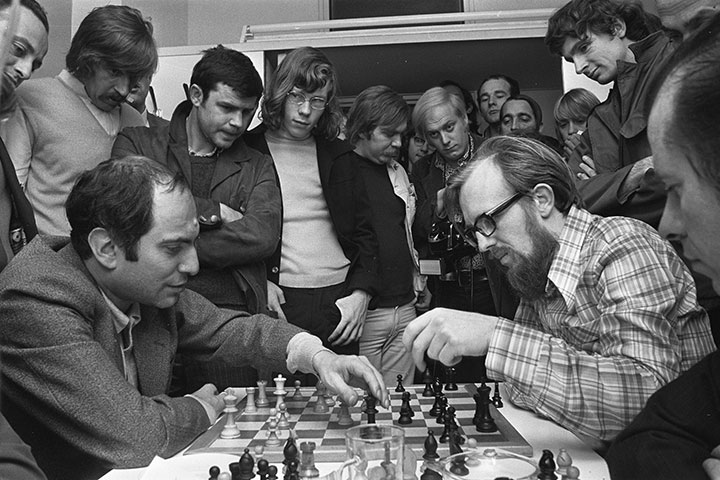
9/6/2020 – Star columnist Jon Speelman was asked to write about Mikhail Tal, and he happily obliged. Speelman points out that, had Misha Tal been alive today, he would certainly be playing blitz and bullet online, and adds, “He was able to play extremely strongly, even in a state in which the rest of us would have struggled to remain upright”. | Pictured: Tal analysing with Dutch IM Coen Zuidema in Wijk aan Zee 1973 | Photo: Dutch National Archive
Your personal chess trainer. Your toughest opponent. Your strongest ally. FRITZ 20 is more than just a chess engine – it is a training revolution for ambitious players and professionals. Whether you are taking your first steps into the world of serious chess training, or already playing at tournament level, FRITZ 20 will help you train more efficiently, intelligently and individually than ever before.
Winning starts with what you know The new version 18 offers completely new possibilities for chess training and analysis: playing style analysis, search for strategic themes, access to 6 billion Lichess games, player preparation by matching Lichess games, download Chess.com games with built-in API, built-in cloud engine and much more.
Throughout the video course, Sasikran shows various examples from his career to explain sacrifices for initiative, an attack, a better pawn structure and much more.
€49.90
The people’s champion
[Note that Jon Speelman also looks at the content of the article in video format, here embedded at the end of the article.]
When I stream at twitch.tv/jonspeelman — at the moment rather sporadically — I sometimes ask for ideas for this column. An Indian guy suggested that I do one on Mikhail Tal, and while we have seen some Tal games recently (notably when he splatted me at the Subotica Interzonal in 1987) I’m very happy to oblige.
In order to become a grandmaster you have at some stage to be obsessed by chess to the point of being in love with the game. It doesn’t have to persist, and while I myself still very much enjoy both playing and watching chess, my relationship with the game has matured to something more akin to a long term marriage than the passion of youth.
Even the world's very best players don’t necessarily have to be crazy about the game — though they presumably very much like winning. And we are very lucky at the moment to have a world champion in Magnus Carlsen who not only obviously really likes playing but is also at times able to take himself sufficiently unseriously to play extended bullet sessions in which he’s bound to lose a serious number of games.
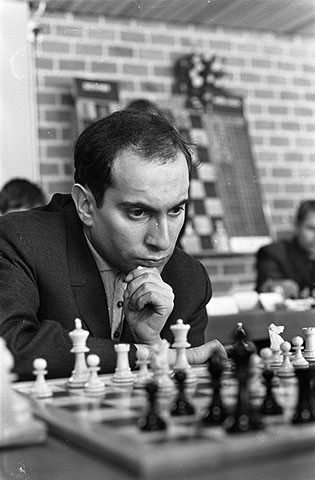
This is something which you couldn’t possibly imagine the Patriarch Mikhail Botvinnk doing (had the technology been available when he reigned supreme): and indeed Botvinnik reportedly disapproved of blitz chess. But you could certainly see Misha Tal playing blitz and bullet on the internet — he was able to play extremely strongly, even in a state in which the rest of us would have struggled to remain upright.
With famous classical examples from the works of the giants, the author talks in detail about principles of chess and methods of play that we can use during every stage of the game.
I discovered this at the end of the Montetaxco Interzonal in Mexico 1985 — in the cycle which preceded the one in which I qualified to the Candidates via Subotica. I had a reasonable tournament but was never in the mix to qualify, while Tal qualified coming third behind Jan Timman and Jesus Nogueiras.
During and after the tournament there were a couple of times when Tal showed just how much he loved chess and how unflappable he was.
In round 3, Tal adjourned against Ahmed Saeed Saeed from the UAE about here. After a couple of hours’ play Tal won, but in the post-mortem after he’d already shown his opponent how to defend, they realized that Black's queenside pawns had been placed wrongly on the board — presumably on a6 and b7. After some sort of appeal by Saeed, it was agreed that they should play again, and Tal calmly accepted this and beat Saeed a different way!
Our experts show, using the games of Botvinnik, how to employ specific openings successfully, which model strategies are present in specific structures, how to find tactical solutions and rules for how to bring endings to a successful conclusion
My second at Montetaxco was Will Watson, the magnificent attacking player who — I think it was Boris Spassky — was described as a “drunken machine gunner”, who later became a very successful lawyer.
At dinner one day during the tournament, one of the other player’s seconds decided to have dinner with us rather than with his principal and his wife. Afterwards one of the iconic conversations in chess history took place, and it went something like:
Principal: “Are you happy?”
Second: “Are you bothering me?”
Principal: “Are you happy?”
Second: “Are you bothering me?”
After which the second was sacked! He definitely lasted longer than I did when I was Victor Korchnoi’s second at the Montpellier Candidates later that year.
After the tournament finished, Will asked Tal if he could play some blitz. Tal was drinking and said that they could do it later, and at some time in the wee hours with Tal fairly stocious Will played him and, not wanting to take advantage of his hero, had a very polite series of games.
When Will had finished, Guillermo Garcia, the Cuban who won one of the big US Opens at one stage (perhaps the World Open?) and very sadly died in a car crash in 1990, sat down opposite the very drunk Tal and set about killing him, drunk or not. On the contrary, Tal slaughtered him!
Tal’s feeling for the initiative and sacrifice has never been bettered.
I could have chosen any of dozens of his games and have gone for this one from the 1960 World Championship match, which I’ve re-annotated taking some notice of the prognostications of our silicon lords and masters, but not too much.
To finish off a very nice if quite slight victory form a few years earlier.
On this DVD Dorian Rogozenco, Mihail Marin, Oliver Reeh and Karsten Müller present the 8. World Chess Champion in video lessons: his openings, his understanding of chess strategy, his artful endgame play, and finally his immortal combinations.
Jonathan SpeelmanJonathan Speelman, born in 1956, studied mathematics but became a professional chess player in 1977. He was a member of the English Olympic team from 1980–2006 and three times British Champion. He played twice in Candidates Tournaments, reaching the semi-final in 1989. He twice seconded a World Championship challenger: Nigel Short and then Viswanathan Anand against Garry Kasparov in London 1993 and New York 1995.
Whether you‘re a beginner looking for a clear roadmap or an advanced player ready to refine your strategic edge, this comprehensive course will transform the way you think about chess.
Biel Chess Festival 2025 with analyses by Aravindh, Navara, Wojtaszek et al. Opening videos by Blohberger, Engel and Sokolov. Training columns ‘The fortress’, ‘Opening traps , ‘Fundamental Endgame Knowledge’ and much more
If you are looking for a practical, easy-to-learn system to sidestep the main lines and catch your opponent off guard, the Two Knights Variation is your perfect weapon against the French!
In this 60-minute course, IM Andrew Martin introduces you to a flexible and refreshingly simple opening setup - that Grandmaster Hikaru Nakamura has used to rack up numerous impressive wins.
ChessBase is re-releasing this timeless classic in the modern ChessBase Media format - complete with brand-new training features. Get ready to rediscover a masterpiece of chess instruction!
We use cookies and comparable technologies to provide certain functions, to improve the user experience and to offer interest-oriented content. Depending on their intended use, analysis cookies and marketing cookies may be used in addition to technically required cookies. Here you can make detailed settings or revoke your consent (if necessary partially) with effect for the future. Further information can be found in our data protection declaration.
Pop-up for detailed settings
We use cookies and comparable technologies to provide certain functions, to improve the user experience and to offer interest-oriented content. Depending on their intended use, cookies may be used in addition to technically required cookies, analysis cookies and marketing cookies. You can decide which cookies to use by selecting the appropriate options below. Please note that your selection may affect the functionality of the service. Further information can be found in our privacy policy.
Technically required cookies
Technically required cookies: so that you can navigate and use the basic functions and store preferences.
Analysis Cookies
To help us determine how visitors interact with our website to improve the user experience.
Marketing-Cookies
To help us offer and evaluate relevant content and interesting and appropriate advertisement.











 In order to become a grandmaster you have at some stage to be obsessed by chess to the point of being in love with the game. It doesn’t have to persist, and while I myself still very much enjoy both playing and watching chess, my relationship with the game has matured to something more akin to a long term marriage than the passion of youth.