7/31/2017 – In the McCutcheon Variation of the French Defense (1.e4 e6 2.d4 d5 3.Nc3 Nf6 4.Bg5 Bb4) Black sharpens the play very early and indicates his wish to win. Opening expert Rustam Kasimdzhanov shows how best to do so. Our reviewer Christian Höthe was impressed.
Your personal chess trainer. Your toughest opponent. Your strongest ally. FRITZ 20 is more than just a chess engine – it is a training revolution for ambitious players and professionals. Whether you are taking your first steps into the world of serious chess training, or already playing at tournament level, FRITZ 20 will help you train more efficiently, intelligently and individually than ever before.
Opening expert and former World Champion Rustam Kasimdzhanov shows you the secrets in the McCutcheon (3.Nc3 Nf6 4.Bg5 Bb4). He shows why Bd2 is no longer the main line and which continuation will be the theory of tomorrow.
There is a reason why the French Defense is considered to be one of the most combative answers to 1.e4. No wonder that players who were not satisfied to draw with Black had the French in their repertoire, e.g. Wolfgang Uhlmann, Viktor Kortchnoi, Lev Psakhis, Rafael Vaganian, Viktor Moskalenko, to name just a few.
If Black wants to spice up things after 1.e4 e6 2.d4 d5 3.Nc3 Nf6 4.Bg5 entering the McCutcheon-Variation with 4...Bb4 is a good choice. Black ignores White's threat and prefers to threaten White's center himself — an interesting and sharp strategy which gave Viktor Kortchnoi a number of fine victories.
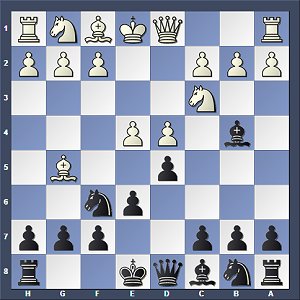
The starting position of the variation after 4.Bg5 Bb4. 90% of all games now continue with 5.e5 h6
Rustam Kasimdzhanov now shows the advantages and disadvantages of the McCutcheon. During the last years a number of books have been published about the McCutcheon — e.g. by Antic/Maksimovic, Aagaard/Ntirlis or Watson — but there was no high-class DVD about this interesting line. Until now!
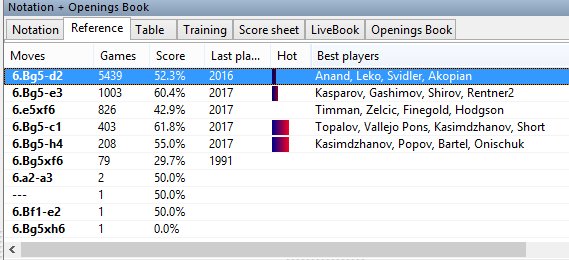
A look into the opening reference in ChessBase 14: After 5.e5 h6 6.Bc1 and 6.Bh4 are currently the latest fashion.
Kasimdzhanov is a very diligent author. In the beginning he quickly but clearly and comprehensively details the current state of theory in the McCutcheon. Among the advocates of the variation are Sergey Volkov, Igor Glek, Ian Nepomniachtchi and many others.
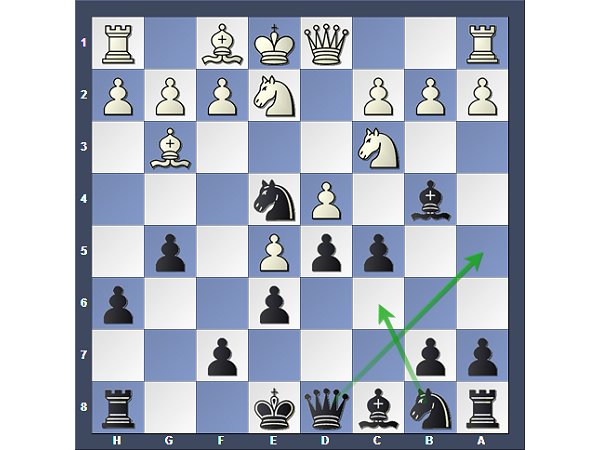
I think it is interesting that the line with 5.e5 h6 6.Bd2 is no longer the main line. Instead 6.Be3 — a move which, as far as I know, John Watson analyzed in detail in his book Dangerous Weapons — the French — is currently the new main line. In his analyses Kasimdzhanov explains why this is so and why White's dark-squared bishop is such an important piece.
Opening expert and former World Champion Rustam Kasimdzhanov shows you the secrets in the McCutcheon (3.Nc3 Nf6 4.Bg5 Bb4). He shows why Bd2 is no longer the main line and which continuation will be the theory of tomorrow.
If White wants to try to surprise Black he might find something in the lines arising after 6.Bh4 or even 6.Bc1. In these lines Kasimdzhanov shows a lot of interesting novelties and possibilities for both sides to sharpen the play as much as possible and to disturb the opponent. I would not be surprised if these lines are the future of the McCutcheon-Variation. It is interesting that French guru Lev Psakhis in 2005 drew attention to these two moves in his book "French: Steinitz, Classical and other variations", indicating that they are underestimated and have potential.
One should not forget one important advantage McCutcheon aficionados do have: usually every good club player knows the first 6 to 10 moves of the line. But how about the middlegame-wrinkles that recently were found for Black, often including dynamic breaks with ...h6-h5 or even ...g6-g5 if White's queen stands somewhat clumsily on g4 or f4? Here is a game of two Elo-heavyweights to illustrate this possibility.
Do you like Black's play? Then the McCutcheon Variation — and this DVD in particular — is what you need!
This impressive DVD has a run-time of almost five tightly packed hours and it contains 78 extensively analyzed illustrative games. It also includes interactive training with video feedback by Grandmaster Kasimdzhanov. This will make it much more easy for you to integrate this razor-sharp line into your French repertoire! I wish you lots of exciting games!
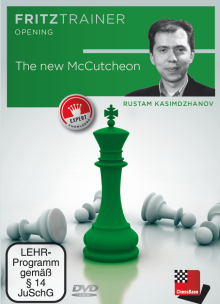
Rustam Kasimdzhanov: The new McCutcheon
• Video running time: 4 hours 42 minutes • With interactive training including video feedback • Full analysis of the variation by Kasimdzhanov • Exclusive database with 78 Grandmaster games • Including CB 12 Reader
29,90 € €25.13 without VAT (for Customers outside the EU) $27.14 (without VAT)
Tournament player, Professional First published: March 2015
Christian HoetheChristian Hoethe was born in 1975, is father of two daughters and one son, lives in Brunswick, Germany, and learned chess relatively late, at the age of 13, from his father. At his peak he reached an Elo of 2247. He plays for the German club SC Wolfsburg where he also teaches once a month.
Whether you‘re a beginner looking for a clear roadmap or an advanced player ready to refine your strategic edge, this comprehensive course will transform the way you think about chess.
Biel Chess Festival 2025 with analyses by Aravindh, Navara, Wojtaszek et al. Opening videos by Blohberger, Engel and Sokolov. Training columns ‘The fortress’, ‘Opening traps , ‘Fundamental Endgame Knowledge’ and much more
If you are looking for a practical, easy-to-learn system to sidestep the main lines and catch your opponent off guard, the Two Knights Variation is your perfect weapon against the French!
In this 60-minute course, IM Andrew Martin introduces you to a flexible and refreshingly simple opening setup - that Grandmaster Hikaru Nakamura has used to rack up numerous impressive wins.
ChessBase is re-releasing this timeless classic in the modern ChessBase Media format - complete with brand-new training features. Get ready to rediscover a masterpiece of chess instruction!
We use cookies and comparable technologies to provide certain functions, to improve the user experience and to offer interest-oriented content. Depending on their intended use, analysis cookies and marketing cookies may be used in addition to technically required cookies. Here you can make detailed settings or revoke your consent (if necessary partially) with effect for the future. Further information can be found in our data protection declaration.
Pop-up for detailed settings
We use cookies and comparable technologies to provide certain functions, to improve the user experience and to offer interest-oriented content. Depending on their intended use, cookies may be used in addition to technically required cookies, analysis cookies and marketing cookies. You can decide which cookies to use by selecting the appropriate options below. Please note that your selection may affect the functionality of the service. Further information can be found in our privacy policy.
Technically required cookies
Technically required cookies: so that you can navigate and use the basic functions and store preferences.
Analysis Cookies
To help us determine how visitors interact with our website to improve the user experience.
Marketing-Cookies
To help us offer and evaluate relevant content and interesting and appropriate advertisement.